Can Drone Seeding Help Restore Pasture at Scale?
Drones can spread seed fast; pasture only recovers when pressure, moisture, and timing align. High-capacity spreaders like the DJI AGRAS T100 change operations—not the ecology—so planning and management still come first.
One of the most attractive ideas in restoration is also one of the easiest to oversimplify:
What if we could use drones to spread seed across large degraded areas and help pasture recover faster?
At first glance, it sounds like exactly the kind of thing dryland restoration needs. Large landscapes. Difficult access. Limited field crews. Pressure to work across more ground. A need to move faster than manual methods alone can usually manage.
So the idea makes sense.
But the real question is not whether drones can spread seed. They can. The more useful question is:
When does drone seeding actually help, and when does it just make a weak restoration plan look more advanced than it is?
That is the question worth taking seriously.
The ecological problem
Pasture recovery is rarely only a seed problem.
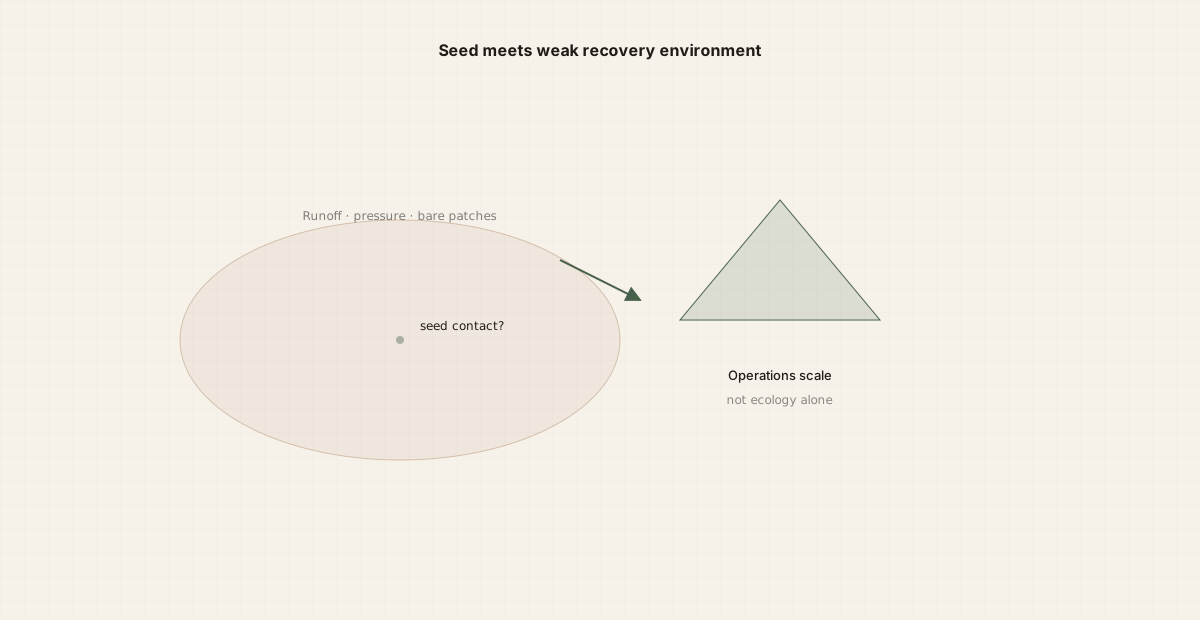
In many degraded dryland landscapes, the problem is not simply that desirable species are absent. It is that the whole recovery environment is weak.
That may include:
- too much grazing pressure
- too little recovery time
- poor water infiltration
- exposed soil
- runoff that strips away moisture
- weak soil surface conditions
- repeated trampling
- poor timing relative to rainfall
So when people say, “Let’s just reseed it,” the land often pushes back.
Because seed alone does not create recovery.
For seed to matter, the landscape usually needs at least some of the following:
- enough moisture at the right time
- reduced pressure long enough for establishment
- reasonable contact with soil
- ground conditions that are not too hostile
- a chance for early growth to hold
That is why drone seeding is best understood as one part of a restoration system, not a restoration system by itself.
Why manual seeding becomes difficult at scale
There are still many situations where manual seeding makes sense.
It can work well when:
- the site is small
- access is easy
- crews are available
- seed placement needs to be very selective
- follow-up management is already in place
But once the landscape becomes larger or harder to reach, manual work starts to become much more difficult.
That may be because:
- distances are too large
- field labor is limited
- timing windows after rainfall are short
- transport is difficult
- terrain is uneven
- multiple zones need treatment quickly
This is where drone seeding becomes interesting.
It offers a way to cover ground faster and, in some cases, reach areas that would otherwise be slow or costly to treat manually. That is the core appeal.
Where drone seeding can genuinely help
Drone seeding is strongest when it is used to support a broader recovery strategy.
For example, it may be useful where:
- a site has already been prioritized through terrain or field assessment
- grazing pressure is being reduced or managed
- rainfall timing creates a short but important establishment window
- access on foot is possible but inefficient
- seed distribution over a wider area is valuable
- restoration teams need a faster way to treat selected zones
In those conditions, drone seeding can help by:
- increasing coverage speed
- improving operational reach
- making short seasonal windows easier to use
- reducing the need to rely only on large manual crews
- supporting more repeatable treatment across multiple sites
That does not guarantee success on the ground. But it does make seeding more operationally viable in places where scale and timing matter.
A useful example: the DJI AGRAS T100
If you want to think about what this looks like in practice, the DJI AGRAS T100 is a relevant example of the kind of platform that could be part of this conversation.
According to DJI’s official product materials, the T100 supports spreading as one of its core operating modes and is positioned as a heavy-payload agricultural drone. DJI states that it has a maximum payload of 100 kg, a 150 L spreading tank, and a maximum discharge rate of 400 kg/min for compound fertilizer, with an effective spreading width of 3–10 m depending on material and conditions. DJI also lists a 2 km max configurable flight radius and a 20 m/s max operation speed on the product page. (DJI)
That matters because it shows the scale of spreading hardware that now exists. This is not just a small hobby drone dropping a few seeds. It is a purpose-built agricultural platform designed for high-throughput field operations. DJI also highlights the T100’s safety stack, including radar and vision-based obstacle sensing. (DJI)
In plain terms, platforms like this make it technically realistic to think about large-area aerial spreading as an operational tool. The harder question is still ecological: will the land conditions allow those seeds to establish?
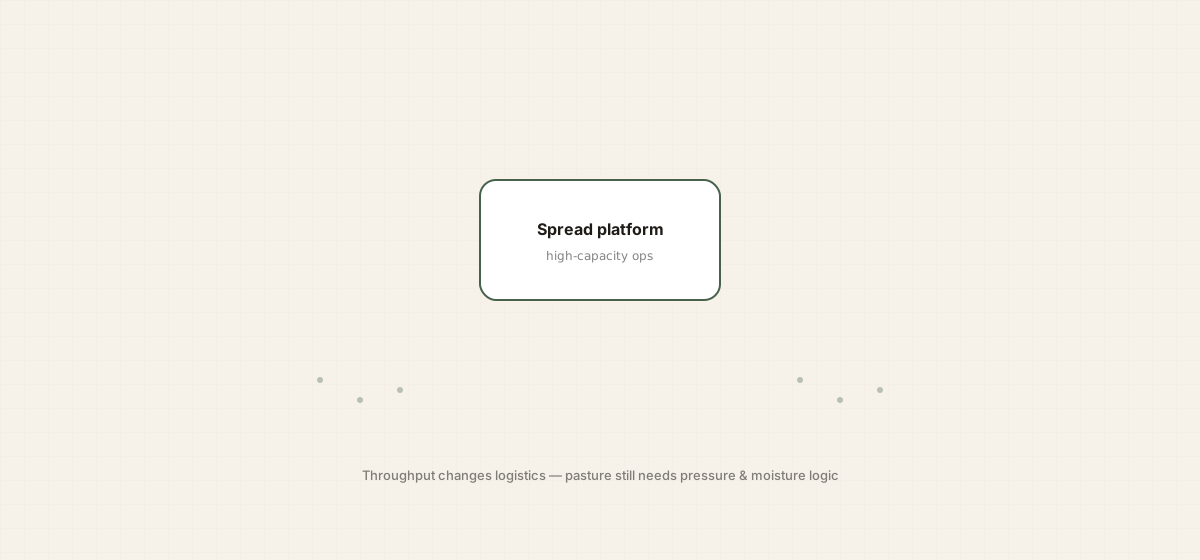
The key point: spreading capacity is not the same as restoration success
This is where people can get carried away.
A high-capacity drone makes aerial spreading possible at a larger scale. It does not automatically make the restoration effective.
A pasture site may still fail to respond if:
- rain does not come at the right time
- the seed mix is wrong
- soil surface conditions are poor
- the area is grazed again too soon
- the selected zone was not actually suitable in the first place
So the drone changes the delivery mechanism, not the underlying ecology.
That distinction matters because it keeps expectations realistic.
A platform like the T100 may solve:
- speed
- coverage
- operational reach
- repeatability of spreading
But it does not solve:
- poor site selection
- unmanaged grazing pressure
- bad timing
- low moisture availability
- weak follow-up
That is why drone seeding should usually sit downstream of good planning, not upstream of it.
Where this could fit in a real restoration model
The strongest role for drone seeding is probably not “blanket restoration everywhere.”
It is more likely to help in a model like this:
- identify priority recovery zones using field knowledge, satellite imagery, and terrain reading
- reduce or manage pressure in those zones
- choose a seeding window linked to rainfall and site conditions
- use drone spreading to treat selected areas efficiently
- monitor what establishes and what does not
- adapt the approach over time
In that model, the drone is not the project. It is one operational tool inside a larger restoration system.
That is a much more useful way to think about it.
Why this matters for pasture recovery specifically
Pasture recovery often depends on broad ground response, not just individual planting points.
That makes aerial spreading appealing because it aligns with the kind of landscape logic pasture systems often need:
- wider treatment areas
- broader vegetation support
- repeatable operational coverage
- targeted work in zones that are large but not necessarily suited to intensive manual intervention
Where drone seeding may be especially interesting is in supporting:
- degraded grazing corridors
- recovery zones near managed pasture systems
- areas where vegetation needs reintroduction after pressure has been reduced
- large sites where manual seeding would be too slow during the useful seasonal window
That is not a guarantee of success, but it is a credible use case.
Why timing matters so much
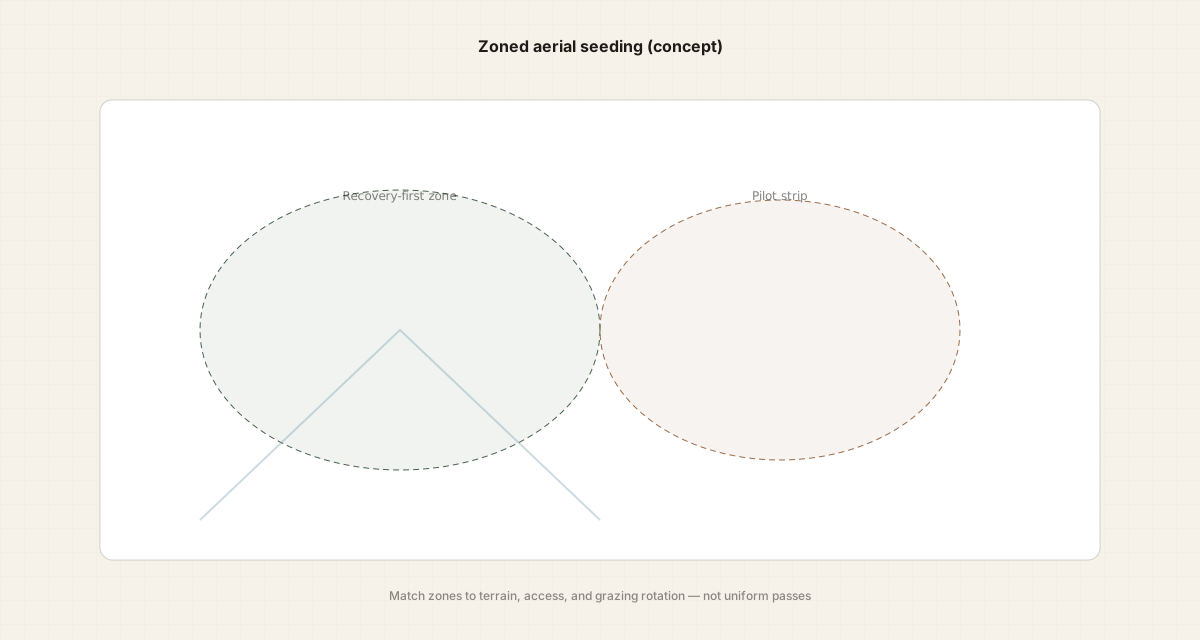
If there is one thing that can make or break aerial seeding in drylands, it is timing.
Because the whole model depends on a simple fact: seed needs a real chance to establish
That means aerial spreading is likely to make more sense when:
- rainfall is expected or has recently arrived
- soil moisture conditions are at least temporarily favorable
- the site is not immediately returning to heavy use
- the treatment is tied to a wider management change
Without those conditions, even highly efficient spreading can become a fast way to waste seed.
So the technology works best when it is tied to ecological timing, not just operational convenience.
Could drones and mapping be combined?
Yes — and that is probably one of the most useful directions.
One of the most practical approaches is to combine:
- site planning and terrain analysis with
- aerial spreading
That means using maps, slope, runoff interpretation, and field validation to decide:
- where seeding is worth trying
- where water is more likely to support establishment
- which areas are too exposed or too pressured
- where recovery zones align with broader landscape logic
Then the drone becomes not just a delivery platform, but part of a more targeted planning-to-execution workflow.
That is much stronger than simply flying over a large degraded area and hoping coverage alone creates outcomes.
What a pilot could look like
A realistic pilot for drone seeding might stay fairly narrow at first.
For example:
- one selected village landscape or grazing area
- one or two priority recovery zones
- site review using terrain and field observation
- temporary or seasonal protection from pressure
- one carefully timed aerial seeding window
- repeat imagery or field checks after rainfall and recovery
- comparison with untreated or manually treated zones where possible
If using a platform like the DJI AGRAS T100, the pilot would mainly be testing whether high-capacity aerial spreading improves the practicality of treatment in selected zones — not trying to prove that the drone alone restores the entire system. DJI positions the T100 as supporting spreading, spraying, and lifting workflows, which makes it relevant as a multi-role operational platform if a program expands later. (DJI)
The useful pilot questions would be:
- Did the selected zones actually establish better vegetation?
- Was the timing right?
- Did drone spreading make treatment easier or faster?
- Did the management around the site support recovery?
- Was the result worth the operational effort and cost?
Those are the questions that matter.
Where this could go next
If aerial seeding proved useful in practice, there are several directions it could grow into:
- pasture recovery programs linked to managed grazing zones
- repeat seasonal treatment plans
- mixed models that combine manual work and aerial spreading
- drone-assisted restoration corridors
- broader baseline and follow-up monitoring using drone imagery
- targeted treatment in hard-to-reach or large areas
And if a platform like the T100 is already in use for other agricultural or field operations, there may be operational efficiencies in using the same system for multiple tasks — though that depends on local logistics, regulation, training, and economics, not just hardware capability. That last point is an inference based on the platform’s multiple official operating modes. (DJI)
Why this matters in Somalia
In Somalia, the attraction of drone seeding is easy to understand.
Large landscapes. Pasture under pressure. Limited field capacity. A need to act quickly when conditions are favorable. A strong reason to think beyond purely manual delivery.
But the same caution also applies: drone seeding will only matter if it is tied to:
- better site selection
- better timing
- better pressure management
- better follow-up
That is why the value is not just in the drone itself. It is in the full restoration logic around it.
Why this matters for Abuur Labs
At Abuur Labs, this is exactly the kind of technology pairing that is worth exploring:
- a real landscape problem
- an operational bottleneck
- a tool that may help
- and a practical pilot model that can test whether it genuinely improves outcomes
The point is not to sound futuristic. The point is to ask whether aerial spreading can make pasture recovery more workable in places where manual approaches alone may struggle.
That is a serious and useful question.
A better way to think about drone seeding
So can drone seeding help restore pasture at scale?
Yes — it can help. But it helps most when it is used as part of a wider restoration system that already takes site planning, rainfall timing, land pressure, and recovery conditions seriously.
A drone like the DJI AGRAS T100 changes what is operationally possible in terms of spreading capacity and coverage. But restoration still depends on whether the land is ready, the timing is right, and the broader system supports establishment. (DJI)
That is where the real opportunity is.
Key takeaway
Drone seeding can make pasture restoration more operationally viable across larger areas, especially with high-capacity platforms like the DJI AGRAS T100, but it only becomes ecologically meaningful when site selection, timing, water conditions, and pressure management are all working with it rather than against it.